

Old God's Time
by Sebastian Barry
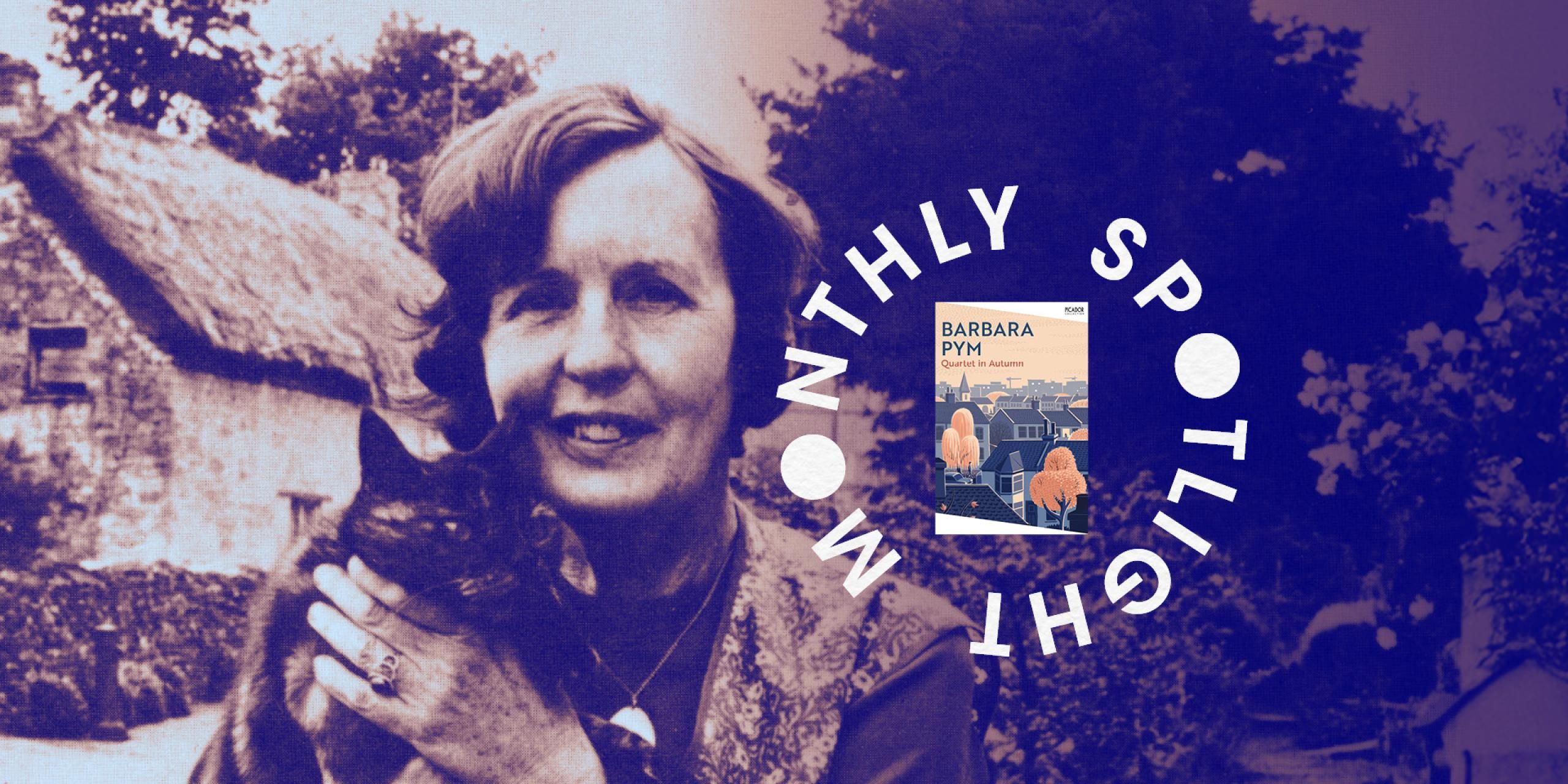
Barbara Pym’s compassionate and funny novel follows four people in late middle-age with different eccentricities but the same problem: loneliness
Quartet in Autumn follows four ageing colleagues as they approach retirement: Letty, Marcia, Edwin and Norman. They are all clerks of some kind, working in the same unspecified London office. Each of them lives alone – unmarried or widowed – and we read about the everyday intricacies of their worlds outside of work.
Although not explicitly friends, the quartet think of, and depend on, interactions with each other more than with anyone else. Lovingly and poignantly, satirically in the gentlest but sharpest way, Pym guides us through their small lives and the facades they erect to defend themselves against the outside world.
Edwin
A widower and devout Christian who avidly attends as many of London’s high church services as he can. Edwin potters from religious mass to religious mass. As a reserved man who values structure, ritual and order, he struggles with friendship etiquette and how not to overstep. He tries his best to help his colleagues as they go through their life changes.
Marcia
A stubborn, slight woman recovering from a mastectomy alone. Marcia barely eats and doesn’t indulge in frivolities, apart from a fancy for her surgeon – Mr Strong. Since her mother died, Marcia lives alone and keeps her mother’s room just as it was. She hoards tinned food and milk bottles. She is monitored by a social worker – which Marcia finds deeply annoying – but still falls through the cracks after her retirement.
Norman
A bachelor living in a bedsit, Norman is known for his cliches and sayings, with his three colleagues often bemoaning yet ‘another of his expressions’. He sometimes goes too far with his metaphors and jokes, offending the others with his insensitivity. Like Edwin, Norman struggles to know how to act with Letty and Marcia. Empathy isn’t always his strong point, but we see him grow more empathetic over the course of the novel.
Letty
Letty is also unmarried and living in a bedsit. Her judgement clouded by prejudice, she leaves her home when a new landlord moves in. She soon regrets this decision as she starts lodging with a bossy older woman in a silent house where Letty finds herself crouching in her room waiting to use the kitchen alone. The most optimistic of the group, Letty puts off moving into a care home in the country and still sees the best in her close friend who finds love but lets her down. Letty believes that life still holds possibility for change.
Barbara Pym was born in 1913 and is one of England’s most treasured novelists. Throughout the 1950s, she wrote and published a series of social comedies, renowned for their poignant yet piercing insights into post-war middle-class life. The best known are Excellent Women (1952) and The Glass of Blessings (1958). In these novels, she chronicles the lives of her heroines: women who are often ordinary, a little lonely and socially marginalised.
In the 1960s, when Catch-22 and Ian Fleming were the bestsellers, Pym experienced a 15-year period where she was deemed almost unpublishable, her novels labelled out of date and touch. Pym commented, ‘the so-called Swinging Sixties were starting and I think quite a lot of publishers had the idea that the kind of thing I was writing was neither saleable nor liked by readers’.
In 1977, Philip Larkin and Lord David Cecil were asked to name their most underrated novelists of the century (for the Times Literary Supplement) and both stated Pym. Shortly after this, Macmillan published Quartet in Autumn which went on to be shortlisted for the Booker Prize 1977.
This inspired a renewed interest in Pym’s past and current work. When she died from abdominal cancer in 1980, she had published eight novels, with several more works then published posthumously. Even today, she is regarded as being in a state of ‘forever being forgotten, then forever revived’. Pym has more recently been discovered by admirers of ‘spinster lit’.
Pym always worked a full-time job throughout her writing career, at the International African Institute in London. There is speculation that she worked as a spy, decoding letters during the Second World War. However, in true Pym-and-proper style, she always denied it.
Barbara Pym
© Mayotte Magnus
Phillip Larkin, Times Literary Supplement
‘She has a unique eye and ear for the small poignancies of everyday life’
Ysenda Maxtone Graham, The Times
‘This is my favourite Barbara Pym novel because it’s not cluttered up with unrequited love, or indeed any love at all. The four main characters’ lives are drained of love. That one of them once offered to make a cup of tea for one of the others is what counts for kindness and warmth in their desiccated lives. Yet we gradually develop love for them as we watch them live out their isolated existences — especially over Christmas, when they somehow get through the dreaded day alone or foisted on charitable relatives or neighbours. Very gradually we realise that, really, they have no one in the world there for them but each other.’
Dame Jilly Cooper, quoted in the Guardian
Pym was the author who ‘brought me more happiness and gentle laughter than any other writer’
Matthew Schneier, New York Times
‘She is a comedian of manners, and a fastidious chronicler of her chosen country, whose map stretches from Anglican suburbia to country parishes and metropolitan London. The church and its ritual provide endless fodder; it gives structure to Pym’s novels, as it gave structure to her life. But it is a misapprehension to think her work speaks only to the devout. There is an agnostic gospel even a nonbeliever can take away from Pym, and it goes like this: Life is full of mild, durable disappointments. It can even be funny.’
Hannah Rosefield, The New Yorker
‘Though the world Pym portrays no longer exists, her characters’ combination of stoicism and optimism feels peculiarly modern. It enables them to develop what Lipsitz called “the emotional resilience and resourcefulness required to live alone”—and not merely to live alone but to take pleasure in doing so.’
‘It’s a crackling, funny novel and at one level joyful and natural to adapt – the crisp, fresh, funny dialogue, characters written with graphic clarity, simple but crafted scenes that mostly happen in one location (the office), the perfect specifics of time and place…
At the same time, Quartet is introspective, delicate, melancholic and quiet, with no explosive plotting… When so much of the novel’s rocket fuel is the comedy and poignancy, the tragedy and redemption, that arises in these gaps between what’s said and what’s meant, how to traverse these gaps? It’s easy in a novel, you just say it. In a play you have to be far cleverer, and I’ve learned through multiple redrafts to have huge respect for this form and to disregard a lot of what I thought I knew about writing.’
Samantha Harvey, winner of the Booker Prize 2024
© David Parry for Booker Prize Foundation
‘At the beginning of 1977, both Philip Larkin and Lord David Cecil wrote of me as “an under-rated writer” in The Times Literary Supplement. As a result of this, Quartet in Autumn was accepted for publication, and two of my earlier books were re-issued. It was marvellously encouraging to be brought back from the wilderness. But it was disquieting too. I wonder how many other novelists have suddenly been told their work is not fashionable or saleable any more, and never been lucky enough to have the generous praise I had from the right people in the right place.
‘And this leads me on to the question of why we write at all. Is it enough just to write for ourselves if nobody else is going to read it? As Ivy Compton-Burnett said in a conversation with her friend Margaret Jourdain, “Most of the pleasure of making a book would go if it held nothing to be shared by other people. I would write for a dozen people… but I would not write for no one. This is what I feel myself—it is those dozen people that spur me on, even when it seems that I’m writing for myself alone. So I try to write what pleases and amuses me in the hope that a few others will like it too.’
Barbara Pym, Finding A Voice: A Radio Talk
Both Letty and Marcia are unmarried women, living alone. Raina Lipsitz called Pym’s rewriting of societal priorities a ‘radical act’. Other critics find that Pym writes that ‘female singleness is temperamental rather than a legal or social status’, which would have stood out at the time of writing. What did you think of Pym’s representation of single life as a retired older woman? Do you think Letty and Marcia’s life choices were bold and radical in the 1970s, and do they seem either of these things today?
To some, Pym can be seen as Jane Austen without happy endings. The Times commented that ‘every sentence in this novel manages to be simultaneously hilarious and almost unbearably bleak’. What do you think Pym has in common with Austen? Is Quartet in Autumn too unhappy a novel, given the loneliness of our protagonists and their quiet lives? Did you find that the book’s comic moments balance the bleak ones, or is the humour too subtle for today’s readers?
Letty and Marcia retire on the same day and are told that no one will be replacing them – their jobs are obsolete. What do you think Pym is saying here? What does it reveal about the work the women have dedicated their lives to?
There are instances of racism throughout the novel, and Letty even moves out of her bedsit when a Nigerian landlord and his family move in. What did the protagonists’ prejudices reveal to you about them as characters and about London (and the UK) in the 1970s? Given that she worked at the Institute of Africa for many years, what are your feelings about Pym’s writing here?
Pym experienced an unpublishable period in the 1960s. She was deemed out-dated, boring and unsellable. Where do you stand on this? Did you find Quartet in Autumn too old-fashioned? Or did you value its nuance and the ways in which it chronicles the everyday life of older people? Do you think readers can relate to it today?
Matthew Schneier in the New York Times notes that, in Pym’s work, ‘women remain nearly invisible to men’. Would you say this is true for Quartet in Autumn? Norman and Edwin think about Marcia and Letty often, but do they see them through a lens of their own vanity? They break into laughter at the thought of visiting the women when they are in need. They resist getting the women ‘mixed up in their consciousness’. The men make mean jokes about the women’s looks and patronise their ‘uses’. Letty and Marcia, on the other hand, seem to view the men very fondly. What did you think of the way Edwin and Norman think about and discuss Letty and Marcia? How do the men’s attitudes compare and contrast with the women’s?
Schneier also states that, ‘to read [Pym] one must have an appetite for endless jumble sales and whist drives, and the interfering wisdom of dowagers and distressed gentlewomen’. She writes about a very particular middle-class. Do you think Quartet in Autumn appeals to a narrow or wide range of readers? Do you think the protagonists have an air of privilege that more working-class readers might feel excluded from, and struggle to empathise with?
On Letty’s first day of retirement, she is excited to wear a suit ‘much too good’ for work and to go to the library to read. This is met with disdain and mockery by her older landlady. Letty asks herself, ‘Why shouldn’t she just read novels and listen to the radio and knit and think about her clothes?’ She has worked for so long and this is now her time. But is it really her time, on her terms? How does Pym explore the ways in which women are watched and judged, and the burden they feel to always be busy?
The New Yorker: Barbara Pym and the New Spinster
The Times: Rereading: Quartet in Autumn by Barbara Pym review — a great English comic wit
Guardian: Author Barbara Pym may have worked for MI5, research suggests
New York Times: In Praise of Barbara Pym
The Barbara Pym Society: Finding A Voice: A Radio Talk
by Sebastian Barry
by Ann Schlee
by Kingsley Amis (prize winner)
by Julian Barnes (prize winner)
by Anita Brookner (prize winner)