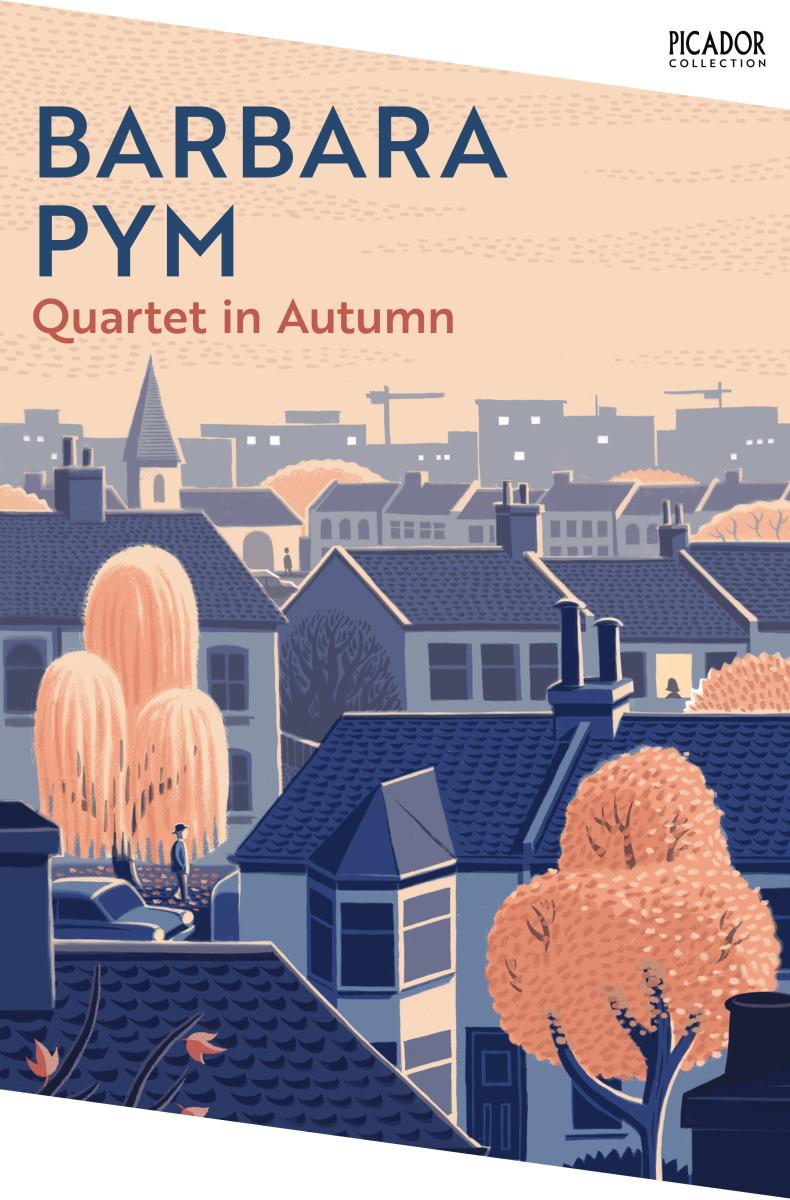

The Booker Prize-winning author of Orbital reveals why she’s always wanted to write a play, and what drew her to adapt Barbara Pym’s Quartet in Autumn for the stage
An extract from Quartet in Autumn by Barbara Pym
An extract from Quartet in Autumn by Barbara Pym
- Published
Barbara Pym’s compassionate and funny novel follows four people in late middle-age with different eccentricities, but the same problem: loneliness
Quartet in Autumn follows four ageing colleagues as they approach retirement. Edwin, Norman, Letty and Marcia’s chief point of contact, at least until the two women retire, is that they work in the same office.
Lovingly and poignantly, satirically in the gentlest but sharpest way, Pym conducts us through their small lives and the facades they erect to defend themselves against the outside world. She also imbues an obstinate optimism in her characters, allowing them, in their different ways, to win through to a kind of hope.
Quartet in Autumn was first published in the UK by Macmillan in 1977.
Buy the book
That day the four of them went to the library, though at different times. The library assistant, if he had noticed them at all, would have seen them as people who belonged together in some way. They each in turn noticed him; with his shoulder-length golden hair. Their disparaging comments on its length, its luxuriance, its general unsuitability – given the job and the circumstances – were no doubt reflections on the shortcomings of their own hair. Edwin wore his, which was thin, greying and bald on top, in a sort of bob – ‘even older gentlemen are wearing it longer now’, his barber had told him – and the style was an easy one which Edwin considered not unbecoming to a man in his early sixties. Norman, on the other hand, had always had ‘difficult’ hair, coarse, bristly and now iron-grey, which in his younger days had refused to lie down flat at the crown and round the parting. Now he did not have to part it and had adopted a medieval or pudding-basin style, rather like the American crew-cut of the forties and fifties. The two women – Letty and Marcia – had hair as different from each other as it was possible to imagine in the nineteen seventies, when most women in their sixties had a regular appointment at the hairdresser for the arrangement of their short white, grey or dyed red curls. Letty had faded light brown hair, worn rather too long and in quality as soft and wispy as Edwin’s was. People sometimes said – though less often now – how lucky she was not to have gone grey, but Letty knew that there were white hairs interspersed with the brown and that most people would have had a brightening ‘rinse’ anyway. Marcia’s short, stiff, lifeless hair was uncompromisingly dyed a harsh dark brown from a bottle in the bathroom cupboard, which she had used ever since she had noticed the first white hairs some thirty years earlier. If there were now softer and more becoming ways of colouring one’s hair, Marcia was unaware of them.
Now, at lunchtime, each went about his or her separate business in the library. Edwin made use of Crockford’s Clerical Directory and also had occasion to consult Who’s Who and even Who Was Who, for he was engaged in serious research in to the antecedents and qualifications of a certain clergyman who had recently been appointed to a living in a parish he sometimes frequented. Norman had not come to the library for any literary purpose, for he was not much of a reader, but it was a good place to sit and a bit nearer than the British Museum which was another of his lunch time stamping grounds. Marcia too regarded the library as a good, free, warm place not too far from the office, where you could sit for a change of scene in winter. It was also possible to collect leaflets and pamphlets setting out various services available for the elderly in the Borough of Camden. Now that she was in her sixties Marcia took every opportunity to find out what was due to her in the way of free bus travel, reduced and cheap meals, hairdressing and chiropody, although she never made use of the information. The library was also a good place to dispose of unwanted objects which could not in her opinion be classified as rubbish suitable for the dustbin. These included bottles of a certain kind, but not milk bottles which she kept in a shed in her garden, certain boxes and paper bags and various other unclassified articles which could be left in a corner of the library when nobody was looking. One of the library assistants (a woman) had her eye on Marcia, but she was unconscious of this as she deposited a small, battered tartan-patterned cardboard box, which had contained ‘Killikrankie oatcakes’, at the back of a convenient space on one of the fiction shelves.
The library assistant, if he had noticed them at all, would have seen them as people who belonged together in some way
Of the four only Letty used the library for her own pleasure and possible edification. She had always been an unashamed reader of novels, but if she hoped to find one which reflected her own sort of life she had come to realize that the position of an unmarried, unattached, ageing woman is of no interest whatever to the writer of modern fiction. Gone were the days when she had hopefully filled in her Boots Book Lovers’ library list from novels reviewed in the Sunday papers, and there had now been a change in her reading habits. Unable to find what she needed in ‘romantic’ novels, Letty had turned to biographies of which there was no dearth. And because these were ‘true’ they were really better than fiction. Not perhaps better than Jane Austen or Tolstoy, which she had not read anyway, but certainly more ‘worthwhile’ than the works of any modern novelist.
In the same way, Letty, perhaps because she was the only one of the four who really liked reading, was also the only one who regularly had lunch out of the office. The restaurant she usually patronized was called the Rendezvous but it was not much of a place for romantic meetings. People who worked in the nearby offices crowded in between twelve and two, ate their meal as quickly as possible, and then hurried away. The man at Letty’s table had been there when she sat down. With a brief hostile glance he handed her the menu, then his coffee had come, he had drunk it, left 5p for the waitress and gone. His place was taken by a woman who began to study the menu carefully. She looked up, perhaps about to venture a comment on price increases, pale, bluish eyes troubled about vat. Then, discouraged by Letty’s lack of response, she lowered her glance, decided on macaroni au gratin with chips and a glass of water. The moment had passed.
Letty picked up her bill and got up from the table. For all her apparent indifference she was not unaware of the situation. Somebody had reached out towards her. They could have spoken and a link might have been forged between two solitary people. But the other woman, satisfying her first pangs of hunger, was now bent rather low over her macaroni au gratin. It was too late for any kind of gesture. Once again Letty had failed to make contact.


Quartet in Autumn
- By
- Barbara Pym
- Published by
- Macmillan
Barbara Pym’s compassionate and funny novel about four people in late middle-age with different eccentricities but the same problem: loneliness
Features

- Book recommendations
Eight novels to read in autumn, nominated for the Booker Prizes
- Reading guides
Reading guide: Quartet in Autumn by Barbara Pym
- Competition
Win a copy of Quartet in Autumn by Barbara Pym


- Book recommendations
Eight Booker Prize-nominated books that celebrate ‘spinster lit’


- Book recommendations