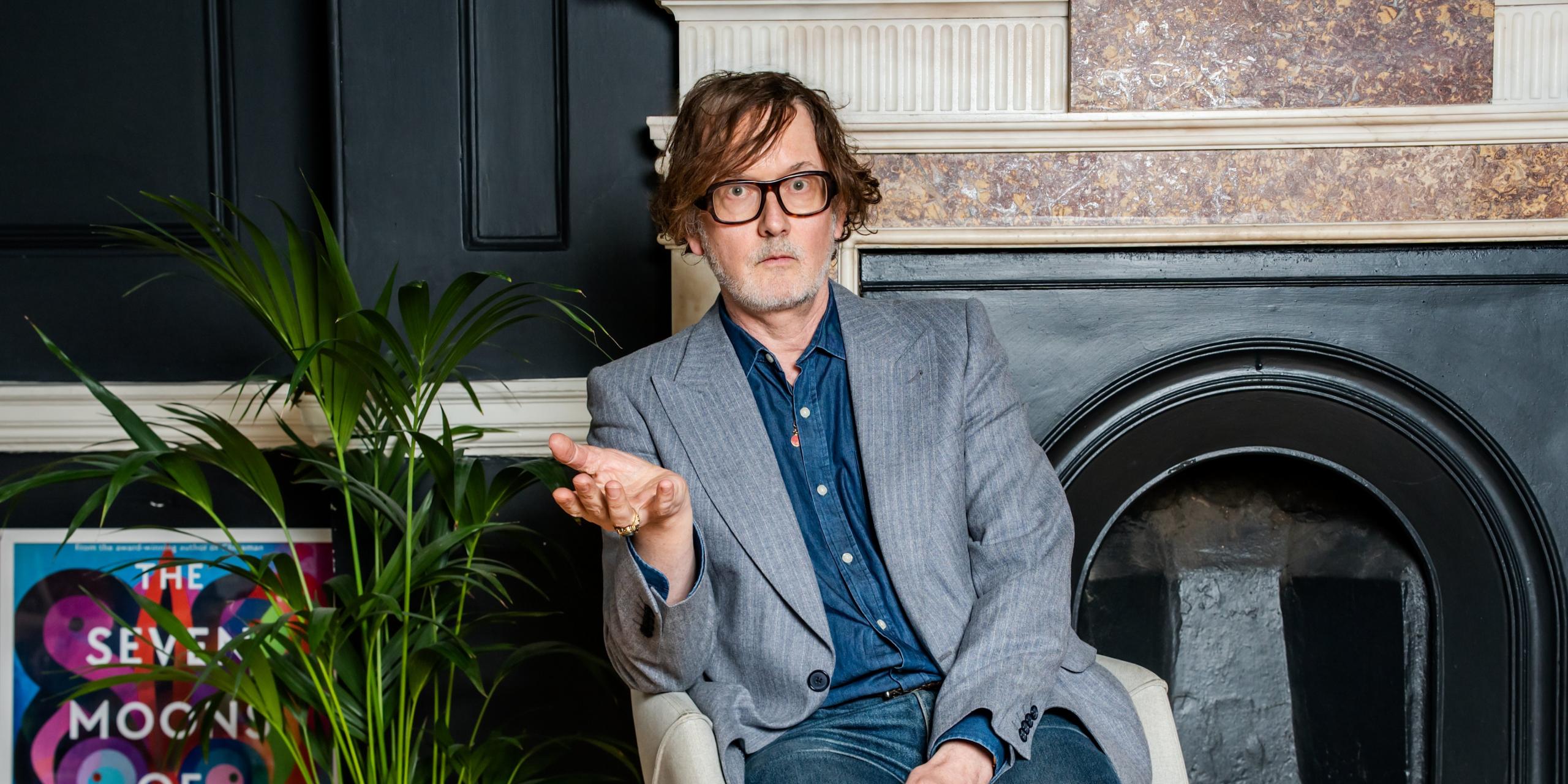
- Published
Booker Prize 2026 judge Jarvis Cocker tells us how reading became the perfect companion to life on tour, and why an unforgettable voice matters more to him than a gripping plot
You will read over a hundred books in seven months as a Booker Prize judge. How are you approaching this challenge, and what are your tips for people who want to find more time for reading but may struggle to fit it around their busy schedules?
It was 163 books in total. I do read quite a lot normally, but not on that level. I wouldn’t recommend reading 163 books in seven months because you read in a different way – you can’t help but compare books to each other. When you’ve got a pile to get through, it’s a different mindset than reading for pleasure.
During my time as a judge, I was very busy. I’ve been on tour with Pulp throughout this whole period, which I found quite useful – the worst thing about being on tour is the travelling, and wondering how to fill those hours. Reading these books for the longlist was useful in those times. Otherwise, people tend to scroll on social media, which makes you feel like a hollowed-out husk of a person. With a book, it’s like you’ve been talking to somebody because reading is like a mainline connection to someone else’s consciousness.
It might seem daunting to read when you’re busy, but you get a lot from it because it can be like punctuation. If you’re stuck with your own thoughts all the time, you can become a bit stagnant, whereas if you have outside stimulus, it can really prompt and inspire you.
Reading is a mostly solitary experience, but judging is a shared one. How does discussing a book with other people change the reading experience, or even your opinion of a book?
I don’t know whether having to discuss it changed the way I read that much. I was aware that I was, shall we say, the least formally qualified person on this jury, but I didn’t really let that bother me. Knowing that the Booker Prizes tend to create panels including people who aren’t necessarily part of the literary world – but can read! – helped me, and I thought I was obviously supposed to bring something that others don’t: a different perspective.
I might have worried about that when I was a bit younger, but I’ve kind of given up on myself now. I know that I am, for better or worse, formed, and so I have opinions which are just there, and there’s not much I can do about them.
What are you hoping to find as you select the books for the longlist? Are there certain qualities or attributes that you’re looking for?
Whenever I read a book, I’m hoping to receive some information that’s going to help me live my life. When I started reading, I thought of books as instruction manuals for being alive; for teaching you how to be a human being. I want to find an author who has looked at the world differently. That’s the magic of human creativity, and certainly the magic of writing: I think writing is the way that someone expresses themselves most directly to you.
As I went through the list of books, I discovered that what I was looking for was not a fantastic plot, but a voice that I was interested in. I wanted to hear how somebody expressed their view of the world – they could be talking about anything, a milk carton or something very mundane, but they’d notice something I hadn’t. That’s what I responded to: authors who made the world come alive through the way they observed it.

The Booker Prize 2026 judges: Raymond Antrobus, Patricia Lockwood, Rebecca Liu, Jarvis Cocker; and Mary Beard
© Neo Gilder for Booker Prize Foundation
What does your day-to-day reading routine look like as a Booker Prize judge?
I didn’t get into a daily routine during the judging process because I was touring with Pulp, so my reading was incorporated into travelling. We had a few long flights, and they were a real godsend, for instance when we flew to New Zealand which was two flights; travelling for a whole day meant I could get through quite a few books.
If we were getting towards a deadline, I would read a couple of books at the same time. If there was one book I wasn’t really getting on with, I might give that a rest, read another one and go back to the other one after. After a while, I was managing to read a book in about two days, which is unheard of for me.
Where is your favourite place to read?
Bed is generally my favourite place. When I’m doing normal civilian reading – not professional reading – I will read in bed before going to sleep. I like that, because then you’ve got ideas that continue moving through your mind when you lose consciousness, and sometimes you can have a good dream directly inspired by something you read before you went to sleep.
Do you ever find yourself reading in unusual places to keep up with the prize schedule? What’s the strangest place you’ve found yourself reading recently?
When I was on tour in France, we played a concert in Lyon, where there is a place called Le Palais Idéal, which is an outsider art environment built by a French postman at the beginning of the 20th century. He used to do his post round and collect stones on the way, and when he got home, he would then build this palace using them. It took him about 30 years, working at night.
I’d been there many years ago when I presented a programme on Channel Four about outsider art environments; it’s an amazing place, and I was quite near to it, so I decided to go. I still had a book that I was trying to finish before going on the plane later that day, so I found a shady corner to sit down and read on a Kindle. This is the first time that I’ve actually read on an electronic device, because I couldn’t really travel around the world with a big sack full of books. That would have been a bit impractical – I was introduced to the world of the e-reader for the Booker Prize.
Reading is like a mainline connection to someone else’s consciousness
What book made you fall in love with reading as a child? How and why did it capture your imagination?
The first book I read was a book called Big Max by Kin Platt, illustrated by Robert Lopshire, which is about a king who had a pet elephant in his walled castle in the middle of a desert. The elephant escapes, but the king couldn’t work out how, so he called in Big Max, the world’s best detective.
I could read before I went to school, and once I learned what those marks on a page meant, that seemed like a magic thing. In that particular story, which was a mystery – when I was reading it as a kid, I couldn’t work out how the elephant escaped, but the fact that the elephant had done this clever thing made me realise that writing is like a magic trick, and I still think that, and that’s when it cast its spell on me. I’ve still got it somewhere, under my bed in London.
What’s your all-time favourite Booker-nominated book and what makes it so special? Who would you recommend it to?
Lincoln in the Bardo by George Saunders, which won the Booker Prize in 2017.
I enjoyed the conceit of it, the different voices, and the idea of what happens to people when they’re dead. Do they realise that they’re dead? It’s quite funny, but also quite scary in parts. That is a book that tells a story differently and tells a story you haven’t heard before. I’d never heard of a book about the son of an American president who died and then went to the bardo – it felt pretty out there. That’s making it sound like it’s a weirdy weirdy woo woo book, but it’s not; it’s very accessible. I would recommend it to anybody, but perhaps it makes more of an impression on you as you get older because you think: ‘maybe I’m going to end up in the bardo myself soon enough’. It’s for anybody interested in human consciousness. It’s a great book.


