
‘He sets down his weapon, then with difficulty takes off his boots, their smell (excrement, musty sweat) adds even more to his exhaustion. His fingers on the frayed laces are dry matchsticks, slightly burned in places; the nails are the same colour as the boots’
- Published
The International Booker Prize 2026 nominated author and translator reflect on their longlisted novel’s different voices and layers, and how fiction resists rigidity
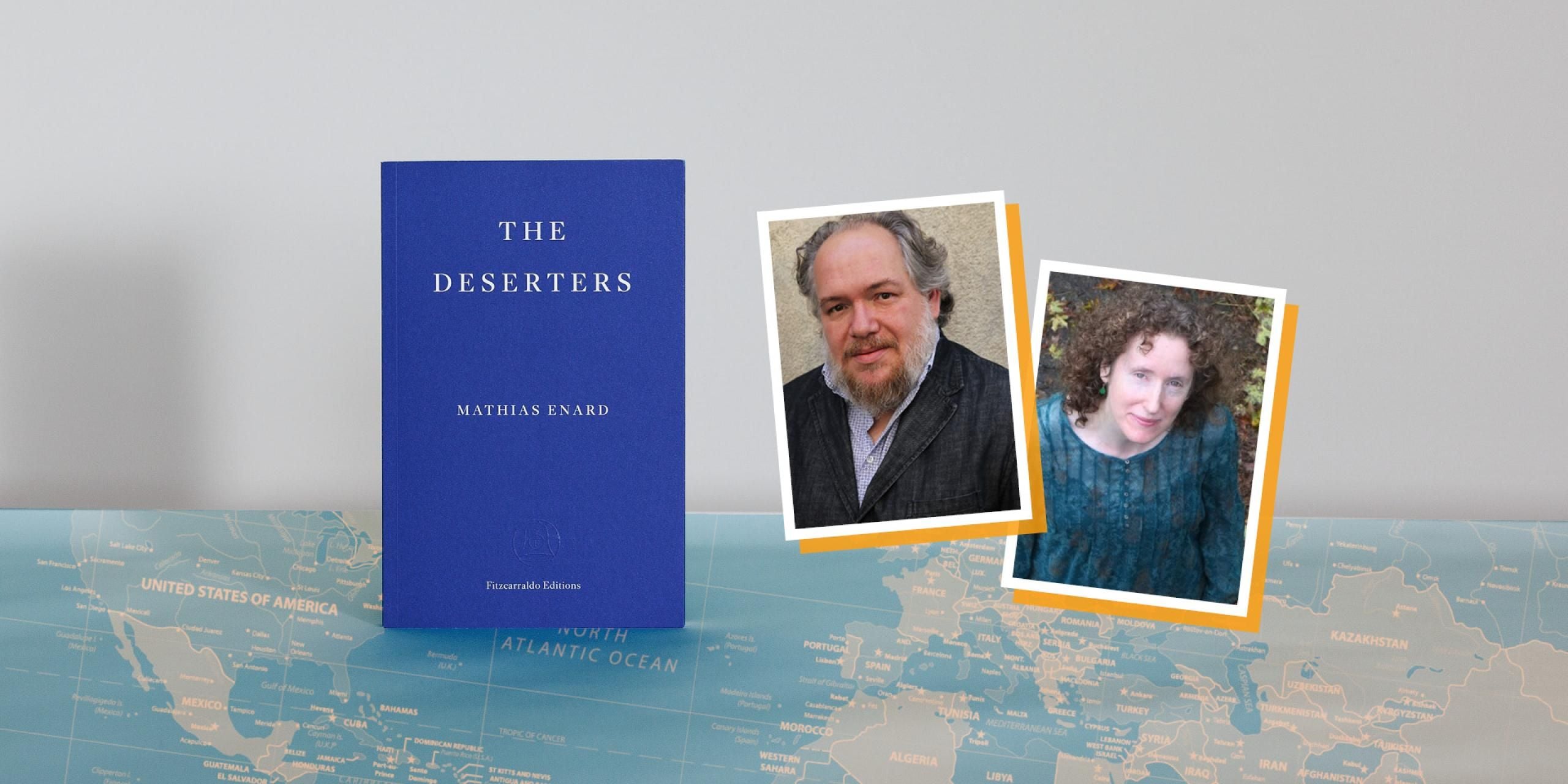
Mathias Énard
Could you tell us about the inspirations behind The Deserters?
The Deserters was born from the desire to place two lives in resonance across time.
One thread follows a nameless soldier fleeing a contemporary Mediterranean war, retreating into nature in an attempt to recover a sense of humanity beyond violence. The other centres on Paul Heudeber, an East German mathematician, former Buchenwald survivor and committed communist, whose life is revisited at a conference disrupted by the shock of 9/11.
I was inspired by the idea of desertion in its many forms – military, political, moral. How do we step away from systems of belief? And what remains when ideologies collapse?
How did you go about writing the novel?
I wrote slowly, over several years, allowing the two narrative threads to find their rhythm. My process is longhand at first – notes, fragments, sketches in notebooks – before moving to the computer.
I like to write in the morning, when the day is still quiet and language feels malleable. Silence is essential; occasionally music helps shape cadence. Research was important, but I try to let documentation dissolve into fiction.
The structure required patience, especially in balancing reflection and narrative tension. I often write at home, surrounded by books. Writing, for me, is a form of wandering – structured, but open to surprise.
The theme of this year’s International Booker Prize is ‘Fiction beyond borders’ – how do you think translated fiction helps readers see beyond geographical boundaries, and why is that important?
Translated fiction reminds us that imagination does not stop at national frontiers. A novel written in Arabic, Japanese or Polish can speak intimately to someone in London or Buenos Aires. Translation creates a shared interior space, where readers experience lives they might never otherwise encounter.
This matters because borders – political and mental – are increasingly rigid. Literature resists that rigidity. It complicates stereotypes and invites empathy. When we read across languages, we accept that our own perspective is partial. Translation is not only a bridge; it is an expansion of consciousness. It allows fiction to travel freely, even when people sometimes cannot.
The International Booker Prize is celebrating its 10th birthday in its current form this year – how do you think the award has changed the perception of translated fiction over the last decade?
Over the past decade, the International Booker Prize has given visibility and prestige to translated literature in a way that feels transformative. By honouring both author and translator, it acknowledges that translation is a creative act. Readers now expect to encounter global voices on equal footing with English-language writers. The prize has helped dismantle the idea that translated fiction is marginal or ‘difficult’. Instead, maybe it is seen as vibrant, contemporary and essential.

Mathias Énard
© Pierre Marquès
Writing, for me, is a form of wandering – structured, but open to surprise
Mathias Énard
Could you tell us about a book that made you fall in love with reading as a child?
As a child, I was mesmerised by One Thousand and One Nights, especially the voyages of Sindbad. Those stories opened vast horizons: seas filled with monsters, islands that were whales, merchants lost and reborn through adventure. What struck me most was the endlessness of storytelling – each tale containing another, like a series of doors. The Nights… taught me that narrative could travel across centuries and cultures. It also revealed the power of imagination as survival: Scheherazade tells stories to live.
And could you tell us about a book that made you want to become a writer?
When I discovered La Prose du Transsibérien et de la petite Jehanne de France by Blaise Cendrars, I felt literature explode into movement. I was 13. The poem travels across Russia, through revolution and modernity, with urgency and colour. It mixes autobiography, myth and history in a single breath.
I was fascinated by its energy – the sense that writing could be both geographic and revolutionary. It suggested that a writer could cross borders, languages and eras without asking permission. That freedom was intoxicating. That maybe I myself could travel and begin to write. Cendrars showed me that literature could be restless, nomadic, and formally daring at once.
Is there a book that changed the way you think about the world?
Reading Drifting Cities by Greek author Stratis Tsirkas profoundly altered my sense of political fiction. Set across cities of the Eastern Mediterranean during the Second World War, it portrays exile, ideology and disillusionment with rare complexity.
What changed me was its refusal of simplicity: revolutionaries are flawed, loyalties shift, cities themselves seem unstable. It showed me that history is lived in fragments, in uncertainty. The Mediterranean appeared not as a border but as a fluid space of encounters. That perspective influenced how I think about Europe, the Middle East, and narrative itself.
Which book written in French should everyone read?
I would mischievously recommend In Search of Lost Time by Marcel Proust. It is extraordinarily long – so it offers excellent value for money. But beyond that joke, it is a cathedral of memory. Proust transforms the smallest sensation – a taste of cake, the unevenness of a paving stone – into vast architecture. Reading him teaches patience and attentiveness. Reading him is an endless flow of pleasure. His language is impossible to imitate. It is demanding, yes, but it reshapes your perception of experience itself.
And, finally, which International Booker-nominated book do you think everyone should read?
I would suggest Celestial Bodies by Jokha Alharthi. Two hints: it traces the intimate transformations of a Gulf society across generations, and its emotional power lies in what remains unspoken between its characters. The novel moves quietly but inexorably, revealing how private lives intersect with historical change. It also demonstrates how Arabic literature can be both rooted in place and universally resonant. Reading it feels like entering a household and slowly understanding its silences, its tensions, and its hopes.
Charlotte Mandell
Could you tell us what it was about The Deserters that made you want to translate it?
I’m always eager to translate anything by Mathias Énard – The Deserters is the sixth novel I’ve translated by him, and I’m currently working on a seventh book by him, a memoir called The Melancholy of Borders: North.
Some of the things I enjoyed about translating The Deserters were its different voices – the two narratives in the book are very different stylistically, and I like the challenge of representing those wildly different voices. I also liked the characters of Irina and Maja, the way we learn about them gradually as the book unfolds, their many layers and sides. There are not many one-sided characters in Énard’s novels; they’re always multi-faceted and surprising.
How did you go about translating the novel?
I never read a book ahead of time; I always read as I translate, sentence by sentence. That way I feel I’m more part of the creative process of writing the book. I figure that the author didn’t have the luxury of reading the book beforehand, so why should I?
That being said, when I finish a first draft I always do several revisions, since some things might come to light at the end of the book that weren’t obvious at the beginning. The Deserters was intriguing in that it kept me wondering how the two narratives would meet, and how they intersect. It was difficult not to skip ahead to find out!
The theme of this year’s International Booker Prize is ‘Fiction beyond borders’ – how do you think translated fiction helps readers see beyond geographical boundaries, and why is that important?
Without translated fiction, we would only be able to read books in our own language, which would limit our worldview drastically. One of the reasons I love being a translator is that I get to write in many different voices, and translate books by many different authors, from different countries; I get to forget about myself and live in another person’s world for a while, and see the world from their perspective. I feel so grateful I can express these different worldviews in my own language.
The International Booker Prize is celebrating its 10th birthday in its current form this year – how do you think the award has changed the perception of translated fiction over the last decade?
I think it’s wonderful that the International Booker Prize rewards author and translator equally: very few prizes do that. Thanks to the International Booker Prize, a wider audience becomes aware of the art of translation; many people who had never noticed a translation realise the difficulties and challenges involved in it, and have a newfound appreciation for translation.
Books that people might not have read before are brought to their attention. Publishers benefit hugely as well when their books are longlisted. Translation is such a difficult and lonely undertaking – it’s wonderful when a major organisation like the International Booker Prize recognises the art of translation and brings the translator into the limelight.

Charlotte Mandell
© Robert Kelly
I get to live in another person’s world for a while, and see the world from their perspective
Charlotte Mandell
Could you tell us about a book that made you fall in love with reading as a child?
I loved The Little Prince by Antoine de Saint-Éxupery – it’s one of the first French books I ever read. I was a voracious reader of myths and fantasy – I loved The Blue Fairy Book, the Norse myths, all the fairy tales illustrated by Carl Larsson, Susan Cooper’s The Dark Is Rising series (a forerunner to the Harry Potter series).
The Little Prince embodied all the things I loved in books: it showed a new way of looking at ‘reality’, it brought magic into the everyday. I read books to discover new worlds and new ways of seeing things, and The Little Prince introduced me not just to a new world, but to a different language. I loved the book so much I adapted it as a play and directed it in my high school, Boston Latin School, where it was the first French-language play ever produced since the school’s founding in 1635.
And could you tell us about a book that made you want to become a translator?
I went to Boston Latin School (founded two years before Harvard), where I studied Latin for five years (as well as French and ancient Greek). Unlike most students at the school, I loved Latin, especially when, as a junior in Advanced Placement Latin class, I got to translate Virgil’s Aeneid.
I loved translating the Aeneid – I loved making a dead language come alive in my own language, and I loved puzzling out difficult sentences, learning new vocabulary. (I recently found my translation in the garage – it’s not bad! Someday I’d like to revise it.) I knew then that translation would always be a part of my life, in some way. I feel so lucky it has become my profession – I can think of few professions as exalted as translation, the art of making another language live and breathe in one’s own.
Is there a translator whose work you always look out for?
Esther Allen is one of my favourite translators; I especially love her translations of Borges and Cendrars. Her translation of Zama by Antonio de Benedetto is a wonder: the way she conveys the narrator’s loneliness and descent into madness is masterful. I know that anything Allen translates will be a pleasure to read.
Is there a work of fiction originally written in French that you’d recommend to English-language readers?
I would recommend Zone by Mathias Énard: a single 517-page sentence, written while the narrator is on a 517-kilometre train ride from Milan to Rome. Each page a kilometre. As readers, we become caught up in the speed of the narrative: the speed and rhythm of the train, but also the speed the narrator is taking to stay awake.
Zone is about all the wars that have taken place up to now, including the Trojan War (Zone has the same number of chapters as the Iliad), but especially the war in Yugoslovia in the 1990s, when the narrator was a Croatian soldier. There’s something hypnotic and mesmerising about the narrative – it was a dream to translate.
And, finally, which International Booker-nominated book do you think everyone should read?
The Deserters, of course! And Compass, which was shortlisted in 2017.


