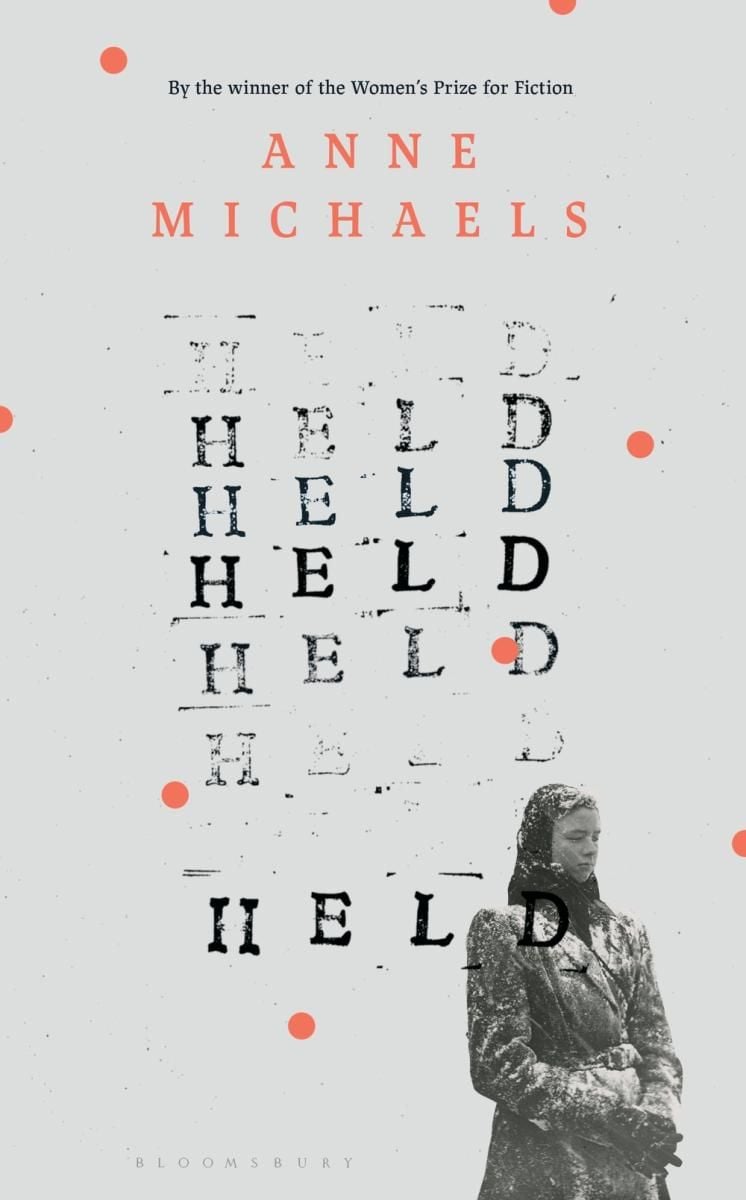

As the Booker Prize 2024 shortlist is announced, we’ve picked out the most interesting facts, trends and themes that have emerged in this year’s selection
Reading guide: Held by Anne Michaels
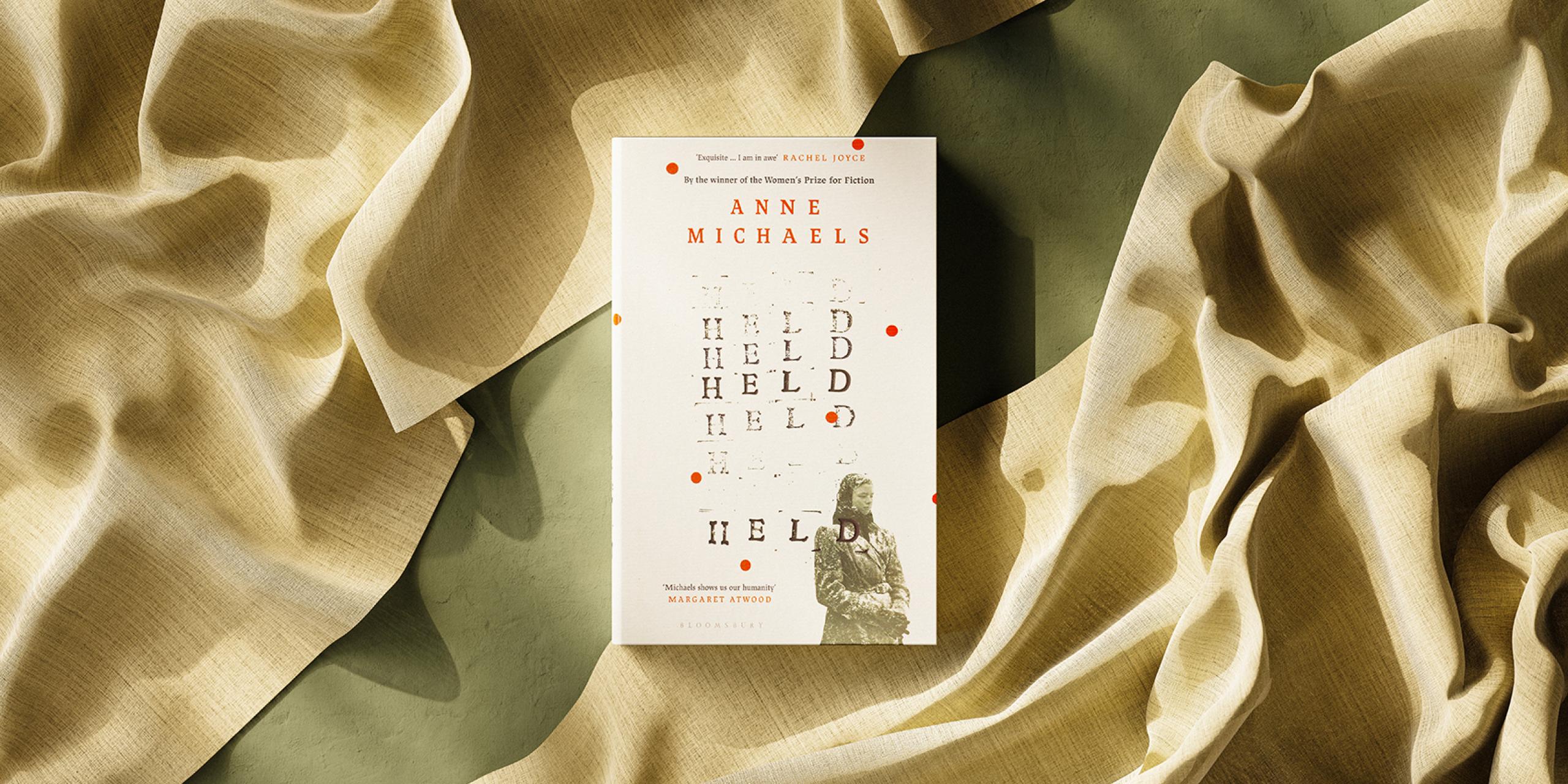
Reading guide: Held by Anne Michaels
- Published
History, memory, love and grief collide in a fragmented narrative that spans four generations of a family
Whether you’re new to Held or have read it and would like to explore it more deeply, here is our comprehensive guide, featuring insights from critics, our judges and the book’s author, as well as discussion points and suggestions for further reading.
Synopsis
Buy the book
1917. On a battlefield near the River Escaut, John lies injured in the aftermath of a blast, unable to move or feel his legs. Struggling to focus his thoughts, he is lost to memory – a chance encounter in a pub by a railway, a hot bath with his lover on a winter night, his childhood on a faraway coast – as the snow falls.
1920. John has returned from war to North Yorkshire, near another river – alive, but not still whole. Reunited with Helena, an artist, he reopens his photography business and endeavours to keep on living. But the past erupts insistently into the present, as ghosts begin to surface in his pictures: ghosts whose messages he cannot understand.
So begins a narrative that spans four generations of connections and consequences that ignite and reignite as the century unfolds. In radiant moments of desire, comprehension, longing, and transcendence, the sparks fly upward, working their transformations decades later.
The main characters
John
John is a soldier who returns to his wife after being injured during the First World War. As he attempts to come to terms with the psychological trauma of his experiences, he finds works as a photographer.
Helena
Helena is John’s wife, a talented artist who constantly doubts her own talent and supports John as he struggles with the vivid memories of his experiences during the war.
Anna
Anna is John and Helena’s daughter; her work as a doctor means she frequently leaves her family to work in war zones.
Mara
Inheriting the same caring nature as her mother, Anna, Mara also becomes a doctor, and is similarly drawn to working in war-torn areas.
About the author
Anne Michaels is a Canadian novelist and poet. Her books have been translated into more than 50 languages and she has won dozens of international awards, including the Orange Prize, the Guardian Fiction Prize, and the Lannan Award for Fiction. Among many other honours she is a Guggenheim Fellow, has received honorary degrees, and has served as Toronto’s Poet Laureate. Her best-known novel Fugitive Pieces was the winner of multiple awards and was adapted as a feature film. Her most recent books include All We Saw, Infinite Gradation and Railtracks (co-written with 1972 Booker Prize winner John Berger). In 2020, her novel Fugitive Pieces was chosen as one of the BBC’s 100 Novels that Shaped the World.

Anne Michaels
© David Levinson / Getty Images
What the critics said
Christian House, Financial Times
‘Her alchemical abilities are undimmed. It is really a novel-in-stories, delivering a series of pivotal junctures in the lives of a string of characters — some obviously linked, others more tenuously. Spanning the 20th century and reaching into the near future, this series of decisive moments presents love, both romantic and familial, as a temporary balm to inevitable loss.’
Alice Jolly, The Observer
‘Michaels works in short, dazzling snapshot scenes, collage-like and even hallucinatory. Each paragraph is as carefully shaped as a poetic stanza … While the fluid structure of this work may be challenging for some readers, it’s clear that Michaels’s writing continues to stand head and shoulders above most other fiction.’
Donna Seaman, Booklist
‘With many scenes in winter along rivers, on trains, and in moonlight rooms, the joys and sorrows of passionate love and grief and the physics of memory are conveyed through the characters’ profound and lyrical musings. How ardently we long to be held in another’s arms and heart. Michaels brings her poet’s finesse and soulfulness to this exquisite, deeply moving paean to love and life’s insistence and beauty.’
Georgia Phillips, The Conversation
‘Like Michaels’ poetry, this tender but fiercely truncated novel combines its sense of loss, silence, history and identity with a desire to grasp the unquantifiable. The balance of tenderness with technical mastery is enthralling. This profound novel begs for a slow and careful reading to peel back all its layers of raw intelligence and beauty.’
‘Meandering back and forth across generations, Michaels’ narrative captures moments of winsome (apparent) coincidence as well as heartbreaking sorrow; more than one young woman loses a husband to death and the threat of war echoes across generations. What is consistent throughout the interwoven lives of the photographers, hat makers, artists, war correspondents, and international crisis workers presented here is the persistent examination of what forces brought them to their destinations. The possibilities include love, chance, particle theory, hope, and desire; Michaels’ poetic amalgamation of the lot results in a multi-layered and subtle discussion of what keeps animating the web of existence. A gorgeous meditation on whether the ghost in the machine is actually in our hearts.’
What the Booker Prize judges said
‘There are very few books that can achieve a pitch of poetic intensity sustained across a whole novel. Through broken stanza-like paragraphs and chapters that move between different members of the family across a century, Held achieves the feat of being deeply moving and asks the question ‘Who can say what happens when we are remembered?’ with tenderness.
‘We loved the quietness of this book: we surrendered to it. The large themes are of the instability of the past and memory, but it works on a cellular level due to the astonishing beauty of the details. Whether it is the mistakes that are knitted into a sweater so that a drowned sailor can be identified, or the rituals of making homecoming pancakes, or what it feels like to be scrutinised as you are painted, the novel makes us pause.’

The Booker Prize 2024 judges with the longlist
©Tom Pilston
What the author said
‘Every day writing this book I asked myself: in these urgent times, what voice might be small enough to be heard; what do we need now. We measure history by events and actions, but this book wants to assert a different measure for history, the real and powerful effect of our inner lives – what we believe, what we value, what we love, what we aspire to. Held explores our conflation of science with technology, the surrender of our ancient relationship with what can’t be seen, and asks why we have so insistently foreclosed on what we have always known – that there is crucial meaning and value in what, necessarily, cannot be proven. Again and again, in different ways, Held asks what forces bring us to a present moment. These forces, from particle physics to evolution, to revolution, to hauntings, to hope, to a gesture, to an error, to empathy, to desire… this is Held’s investigation; and the ways we choose and all the ways beyond our choosing, and all the ways love continues its work long past the span of a life.’
Read the full interview here.
Questions and discussion points
Anne Michaels’ background as a poet is a clear influence on Held, the language of which is spare, challenging and full of vivid imagery. The Booker judges said that ‘few books can achieve a pitch of poetic intensity sustained across a whole novel’. How did Held’s ‘poetic intensity’ affect your reading of the novel? Did it heighten the book’s emotional impact?
Held is structured unconventionally as a series of fragments, moving forwards and backwards in time, rather than as a traditional linear novel. Why do you think Michaels structured the book in this way? Could its fragmentary nature be seen as a more accurate representation of the way we experience and remember our lives than novels that follow a more conventional path?
In an interview with the Booker Prizes, Michaels said, ‘We measure history by events and actions, but this book wants to assert a different measure for history, the real and powerful effect of our inner lives – what we believe, what we value, what we love, what we aspire to’. To what extent would you say Michaels has succeeded in asserting this ‘different measure’?
Writing in the Guardian, Lucy Hughes-Hallett wrote that the individual stories in Held ‘are told in glimpses. It is for the reader to join the dots.’ Would you agree with this statement and how easy or difficult was it to fill in the often significant gaps in the narrative?
The Booker judges said ‘We loved the quietness of this book, and we surrendered to it.’ Would you agree that Held is a ‘quiet’ novel, and to what extent is that a special or positive quality? Did you surrender to it, too?
In the book, John and Helen run a photography business; Alan is a war photographer. Discuss the role that photography plays in the book and how it relates to the fact that Held is structured as a series of powerful and highly visual snapshots.
The book contains supernatural elements, such as when the photographs developed by John show ghostly apparitions of the dead. In a book about love, grief and the effects of trauma, why do you think Michaels introduced these otherworldly elements that defy explanation, and how did they affect your reading of the book?
Writing in The Conversation, Georgia Phillips wrote: ‘At the centre of Held is the dichotomy between a scientific worldview and the more elusive forces that shape life.’ Discuss the role that science plays in the novel, including the fact that real-life scientists – Ernest Rutherford and Marie Curie – appear as characters.
Readers have speculated on the meaning of the book’s title, and whether it refers to the physical act of holding or being held by a loved one, or the experience of holding a person or image in one’s memory, or even the way opposing forces are held in balance. What does the title mean to you?
Watch our film

Resources and further reading
Good Reading Magazine: Held by Anne Michaels
CBC: Anne Michaels examines how history is inextricable from the story of our inner lives
Toronto Star: From the ghosts of war to science, Anne Michaels considers humanity’s relationship to invisibility in ‘Held’
The Independent: War, ghosts and poetry: Inside the intense mind of Canadian novelist Anne Michaels
If you enjoyed this book, why not try
Fugitive Pieces by Anne Michaels
The English Patient by Michael Ondaatje
This Strange Eventful History by Claire Messud
Unexploded by Alison MacLeod

The English Patient by Michael Ondaatje
Held
- Published by
- Bloomsbury Publishing
In a narrative that spans four generations, moments of connection and consequence ignite and re-ignite as the century unfolds


Features
- Book recommendations
Eight Booker-nominated books for fans of Wuthering Heights

- Book recommendations
Booker Prize authors on the childhood books that made them fall in love with fiction

- Book recommendations
11 Booker Prize-nominated novels that explore the passage of time

- Long read
- Information
Meet the designers behind the Booker Prize 2024's bespoke bound books

- Information
- Interview
The Booker Prize Indie Bookshop Spotlight competition 2024: Meet our winning booksellers


- Book recommendations
- Interview
The 2024 shortlistees on the book that challenged their worldview

- Book recommendations